
Server Room Safety: Choosing a Reliable Exporter of Extension Cord with Surge Protector for High-Capacity Racks


(YorkPedia Editorial):- Jiangmen, Guangdong Aug 2, 2026 (Issuewire.com) – In the heart of a modern data center, the rhythmic hum of high-capacity racks serves as the pulse of digital operations. For one IT manager, that rhythm was shattered by a subtle, creeping hazard: an electrical surge. Following a localized power spike, several critical storage nodes in a high-capacity rack began to fail intermittently, leading to data corruption and hours of costly downtime. It wasn’t a catastrophic explosion; it was the slow, silent degradation of hardware caused by inconsistent power delivery. This scenario highlights a frequently overlooked vulnerability in server room safety: the quality of the power distribution infrastructure. Selecting a Reliable Exporter of Extension Cord with Surge Protector is not merely an operational choice; it is a fundamental strategy for maintaining server stability. An Extension Cord with Surge Protector acts as the first line of defense, intercepting harmful transient voltages before they reach sensitive networking equipment, thereby preventing data loss and extending the lifespan of hardware.
Understanding the Stakes: Why High-Capacity Racks Require Specialized Power Solutions
High-capacity racks have become the backbone of enterprise computing, housing dense arrays of servers, switches, and storage devices that support everything from cloud applications to real-time industrial analytics. Unlike traditional office setups, these racks demand high-density power delivery where every socket is critical. When multiple power-intensive units are daisy-chained without adequate surge protection, the risks multiply exponentially.
The Hidden Risks of Substandard Power Distribution
Choosing a reliable provider for your power delivery components is essential for avoiding several key hazards:
- Transient Voltage Spikes:Even minor fluctuations in the power grid can introduce voltage spikes. Without industrial-grade surge protection, these spikes can damage microprocessors, capacitors, and internal power supplies, leading to unpredictable system crashes.
- Thermal Overload:High-capacity environments generate significant heat. Inferior extension cords often use thinner copper wiring or sub-par insulation, which can lead to localized heating, increasing the fire risk within the enclosed space of a server rack.
- Operational Instability:Intermittent power issues are more damaging than total failure because they are harder to diagnose. A server that periodically reboots due to unstable voltage can compromise the integrity of database transactions, creating complex recovery challenges.
For modern enterprises, the cost of a few minutes of downtime far outweighs the investment in professional-grade surge protection. Integrating robust electrical infrastructure is a proactive measure against the escalating threats of modern electrical environments.
Surge Protection Technology: Principles and Benefits
At the core of an effective Extension Cord with Surge Protector is the Metal Oxide Varistor (MOV) or similar suppression circuitry. This technology functions by monitoring the incoming voltage and diverting excess energy to a grounding path the moment a surge is detected, effectively “clamping” the voltage to a safe level for sensitive electronic components.
When designing high-capacity rack environments, the quality of these components is paramount. Heikki emphasizes rigorous manufacturing standards to ensure these protection mechanisms are reliable under continuous, heavy-load conditions. For instance, testing protocols such as continuous current loads and flame-retardant housing evaluations are critical benchmarks that distinguish industrial-grade equipment from consumer-market variants. By adhering to international standards like ISO 9001 and 14001, manufacturers ensure that every unit delivered provides consistent protection, whether it is used in a local office server closet or a large-scale data center.
Engineering Reliability: The Manufacturer Perspective
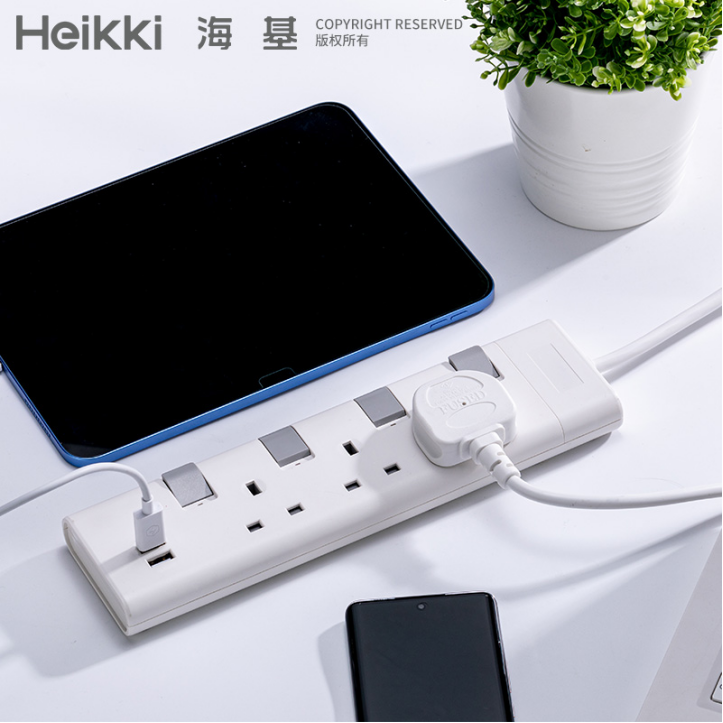
Ensuring server room safety requires more than just buying a surge protector; it requires sourcing from an entity with full-cycle engineering capabilities. Professional manufacturing involves a deep commitment to technical standards, from the selection of fireproof housing materials to the internal architecture that maintains electrical integrity under 24/7 operation. For instance, high-end power solutions–such as those exemplified by the Heikki U31 series–are engineered with meticulous attention to detail. These units utilize fireproof PP materials capable of withstanding temperatures up to 750°C, ensuring that even in dense, high-heat server environments, the power infrastructure remains inherently safe. The internal design leverages high-quality, full-copper wiring (3×1.25mm²) to guarantee stability and prevent overheating under continuous, heavy-load conditions.
Innovation Through Rigorous Testing
For enterprises managing global operations, the complexity of regional regulatory requirements–such as BS1363, CE, or CCC–cannot be ignored. A reliable exporter does not merely produce a commodity; they provide a compliant, tested solution that integrates seamlessly into global infrastructure projects. True engineering reliability is validated through exhaustive testing protocols. Take the development cycle for Heikki’s latest power hubs: every design undergoes stringent durability assessments, including anti-drop structural tests verified over 9,000 repetitions and socket lifespan validations reaching 15,000 insertions. Furthermore, these units are subjected to continuous current testing to support a stable 14A load and thermal performance tests that confirm operational stability at 70°C. This level of technical oversight is what ensures that when a rack is populated, the power backbone remains the most reliable component in the cabinet, not the weakest link.
Ultimately, the goal of integrating high-quality surge protection is to create an environment where the hardware is shielded from the unpredictable nature of electrical grids. By focusing on durable design, material science, and strict adherence to international safety certifications, IT managers can effectively mitigate the risks of surge-induced hardware failure. Modern solutions now often incorporate dual-pole switching and wide adapter spacing to accommodate the varied plugs found in high-capacity server setups, further reducing the physical stress on connections. Protecting the high-capacity rack is about securing the data and the continuity of the entire organization; it is about choosing hardware that has been tested to survive the rigors of the modern, high-demand digital landscape.
For more information on reliable power solutions, please visit our website at https://www.heikkitech.com/
This article was originally published by IssueWire. Read the original article here.
